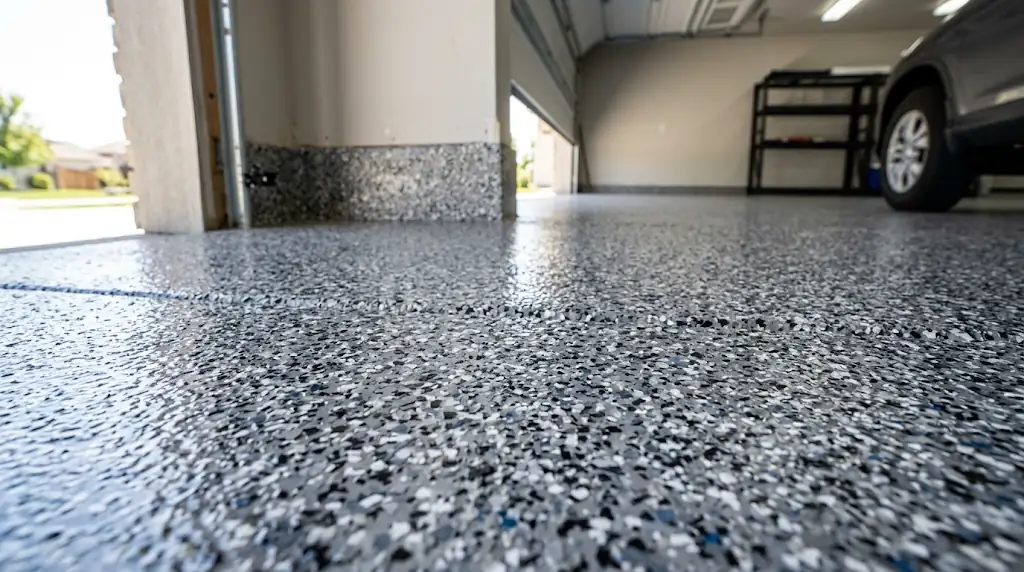
The average cost for professional garage epoxy flooring in the Treasure Valley ranges from $4.50 to $9.00 per square foot. This means a standard 400-square-foot two-car garage in Boise or Meridian typically costs between $1,800 and $3,600 to coat. The final price depends directly on the physical condition of the concrete, the exact square footage of the space, and the specific chemical system applied to the floor.
The Treasure Valley Garage Epoxy Cost Breakdown
A baseline understanding of regional square-footage costs allows for accurate project budgeting. These figures represent total turnkey installation by local professionals. A standard professional installation includes mechanical concrete preparation, patching, primer application, the base color coat, full vinyl flake broadcasting, and a clear protective topcoat.
| Garage Size | Approximate Square Footage | Estimated Cost Range |
| 1-Car Garage | 250 sq. ft. | $1,125 – $2,250 |
| 2-Car Garage | 400 – 500 sq. ft. | $1,800 – $4,500 |
| 3-Car Garage | 600 – 750 sq. ft. | $2,700 – $6,750 |
| Oversized/RV Shop | 800+ sq. ft. | $3,600+ |
(Note: Regional pricing aligns with national garage floor cost averages reported by Forbes Home.)
Core Factors Driving the Cost
Not all garage floors cost the same to coat. Five primary variables dictate the final price of an epoxy or polyaspartic garage floor in Idaho.
- Existing Concrete Condition: New, unblemished concrete requires standard mechanical diamond grinding. Old concrete with heavy spalling, deep cracks, pitting, or existing failing paint requires extensive patching and surface profiling. Repairing severe structural surface damage increases labor and material costs.
- Concrete Surface Profile (CSP): Proper adhesion requires grinding the concrete to a specific texture, usually a CSP-2 or CSP-3. Slabs constructed with incredibly hard concrete require specialized, expensive diamond tooling to achieve the correct profile, slightly increasing labor times.
- Coating Chemistry: 100% solids epoxy is the industry standard for durability and deep concrete penetration. Polyaspartic coatings cost slightly more per square foot but cure faster and provide superior UV resistance.
- Moisture Vapor Transmission (MVT): Garages built in areas with high water tables or poor drainage emit moisture vapor through the slab. High moisture readings dictate the application of a specialized vapor barrier epoxy primer. This adds a dedicated moisture-mitigating layer to the per-square-foot cost.
- Decorative Finishes: A standard full-broadcast vinyl flake floor is the most common residential system. Custom metallic epoxies, quartz systems, or custom logo inclusions require specialized application techniques and higher material expenses.
Why Treasure Valley Weather Demands High-Quality Coatings
The climate in the Boise Metro Area poses unique challenges for concrete slabs. A standard DIY epoxy paint kit fails rapidly under these environmental stresses.
- Extreme Temperature Fluctuations: The Treasure Valley experiences drastic seasonal shifts. Summer days routinely exceed 100°F, while winter temperatures frequently drop well below freezing. This thermal shock causes the concrete slab to constantly expand and contract. High-quality professional epoxies and polyaspartics possess the elastomeric flexibility to move with the slab without fracturing.
- Freeze-Thaw Cycles: Winter snow brought into the garage on vehicle tires melts and seeps into bare concrete pores. When temperatures drop, this water freezes and expands, causing the concrete surface to spall and chip. A seamless epoxy coating completely seals the porous concrete, preventing moisture penetration and eliminating freeze-thaw damage.
- Hot Tire Pick-Up: Summer asphalt temperatures in Meridian and Nampa easily exceed 140°F. When a vehicle is parked in the garage, that extreme heat transfers from the tires directly to the floor. Cheap box-store paints melt under this thermal shock and peel off onto the tires. Professional-grade 100% solids epoxy and polyaspartic topcoats withstand these extreme temperatures without delaminating.
Epoxy vs. Polyaspartic: Material Cost Differences
Contractors in Eagle, Star, and Kuna frequently offer both epoxy and polyaspartic systems. Understanding the chemical differences clarifies the price variations.
- Standard Epoxy Systems: Epoxy creates an incredibly strong, thick bond with the concrete. It takes longer to cure (typically 3 to 5 days before returning to normal vehicle traffic). It is generally the most cost-effective professional option for base coats.
- Polyaspartic Systems: Polyaspartic is an aliphatic polyurea. It is highly UV stable, meaning it will not amber or yellow when exposed to direct sunlight at the garage apron. Polyaspartic cures rapidly, often allowing for a one-day installation and a next-day return to service. Because of the accelerated cure times and UV stability, polyaspartic topcoats generally command a 15% to 25% premium over standard epoxy topcoats.
- Hybrid Systems: The most resilient, high-performance systems combine the two materials. A moisture-mitigating epoxy acts as the deep-penetrating primer, followed by the vinyl flake broadcast, and sealed with a high-build polyaspartic topcoat for UV protection and rapid return to service.
Hidden Costs and Project Add-Ons
Property owners must account for site-specific physical conditions that fall outside standard square-footage pricing matrices.
- Mastic and Glue Removal: Converting a former living space back into a garage requires removing old VCT tile glue, linoleum adhesive, or carpet mastic. Mechanical removal of these thick adhesives heavily degrades grinding tools and adds direct labor costs.
- Stem Wall Coating: Coating the vertical concrete stem walls (the short foundation lip around the perimeter of the garage) requires specialized thickening agents so the epoxy does not sag, along with tedious hand-troweling. This is typically billed linearly (per linear foot) rather than by square footage.
- Expansion Joint Filling: Filling the saw cuts and expansion joints with a flexible polyurea joint filler creates a seamless, sanitary floor. Leaving them open is cheaper, but filling them prevents dirt accumulation, stops water intrusion into the sub-base, and provides a superior aesthetic finish.
- Step and Stair Coating: Many garages feature concrete steps leading into the house interior. Coating the risers and treads requires detail-oriented hand-grinding, adding specific line-item costs.
Does Epoxy Flooring Increase Home Value in Ada and Canyon Counties?
Yes. A professionally installed garage floor coating delivers a measurable return on investment for Treasure Valley homeowners.
- Appraisal Value: While it does not add directly to the heated, livable square footage, finished garages are recognized mechanical upgrades in real estate appraisals.
- Buyer Appeal: In competitive real estate markets like Boise and Meridian, a finished garage acts as a strong visual differentiator. It immediately signals to buyers that the home has been meticulously maintained.
- Usable Space: Coating the floor transforms the garage from a dusty parking zone into a clean, functional extension of the home. Dust elimination makes the space suitable for home gyms, workshops, or recreational areas.
Lifespan and Maintenance Costs in Idaho Garages
The true cost of a floor includes its longevity and mandatory upkeep. Professional garage coatings offer the lowest lifetime cost of any garage flooring option.
- Expected Lifespan: A properly prepared and installed epoxy or polyaspartic floor in a residential garage lasts 15 to 20 years before requiring a clear topcoat recoat. The base coats remain bonded indefinitely.
- Cleaning Protocol: Maintenance costs are near zero. Routine care requires only a dust mop for dry debris. For wet mopping, a mixture of hot water and a pH-neutral cleaner (like Simple Green or clear ammonia) easily removes grime.
- Chemical Resistance: The non-porous surface resists permanent staining from engine oil, transmission fluid, antifreeze, and the magnesium chloride road salts used during Idaho winters. Chemical spills wipe up effortlessly without leaving a residue.
Securing an Accurate Quote for Your Garage
Every concrete slab in the Treasure Valley is unique. General pricing guides provide a starting point, but a site-specific evaluation is required to determine the exact installation cost. Professional estimators must measure the exact square footage, perform a moisture vapor transmission test, and assess the hardness of the concrete (using the Mohs hardness scale) to determine the correct diamond grinding tooling needed for the project.
Contact Meridian Epoxy Flooring to schedule a precise, on-site measurement and concrete assessment. Visit our contact page today to get a custom, itemized quote for your home in Meridian, Boise, Nampa, Caldwell, Eagle, Kuna, or Star.