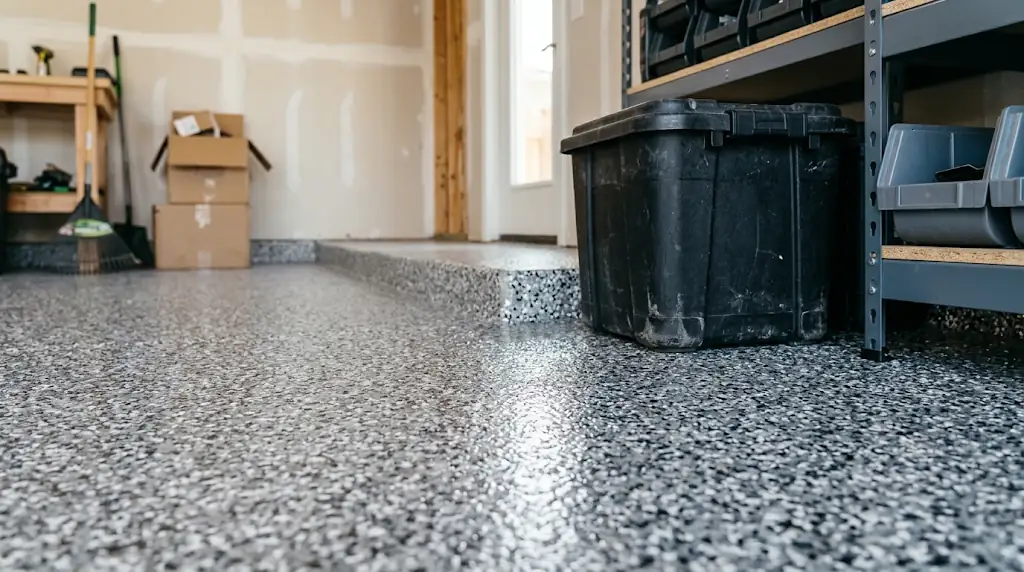
A standard professional garage epoxy flooring installation in the Treasure Valley takes two to three days to complete, followed by a mandatory 48 to 72-hour curing period before returning to normal vehicle traffic. High-performance polyaspartic systems accelerate this timeline, allowing contractors to complete the physical installation in a single day with a 24-hour return-to-service window.
The Standard Multi-Day Installation Timeline
Understanding the exact breakdown of the installation process prevents scheduling conflicts. The timeline for a standard 400-square-foot, two-car garage in Boise or Meridian relies heavily on mechanical preparation and chemical curing windows.
| Project Phase | Estimated Time | Action Performed |
| Day 1: Preparation | 4 – 6 Hours | Diamond grinding, crack routing, joint filling, patching |
| Day 1: Base Coat | 2 – 3 Hours | Primer application, color coat, heavy flake broadcast |
| Overnight Curing | 12 – 16 Hours | Chemical cross-linking of the base layers |
| Day 2: Topcoat | 3 – 4 Hours | Flake scraping, vacuuming, clear topcoat application |
| Day 3: Foot Traffic | 24 Hours | Safe for light, cautious pedestrian walking |
| Day 4-5: Vehicle Traffic | 48 – 72 Hours | Full chemical cure; safe for hot tires and heavy loads |
(Note: Standard curing times align with structural resin manufacturer guidelines as detailed by industrial construction resources like Bob Vila.)
Day 1: Mechanical Preparation and Base Coats
The longest and most labor-intensive portion of any garage floor coating occurs before a single drop of chemical hits the floor. Proper adhesion requires aggressive physical modification of the concrete slab.
- Diamond Grinding: Contractors use massive, heavy-duty planetary floor grinders equipped with metal-bond diamond tooling. This removes the smooth upper layer (laitance) of the concrete, opening the microscopic pores to a Concrete Surface Profile of CSP-2 or CSP-3. This phase typically takes 3 to 4 hours.
- Structural Repairs: Cracks, spalling, and pitting are routed out with hand grinders. The crew fills these voids with rapid-curing polyurea or epoxy paste. Depending on the damage, patching adds 1 to 2 hours to the prep phase.
- Moisture Mitigation: If the slab tests high for moisture vapor transmission (MVT), a dedicated vapor barrier primer is applied first.
- The Flake Broadcast: Once the foundational epoxy base coat is rolled onto the floor, the crew immediately broadcasts decorative vinyl chips until the floor is completely covered (to rejection). The floor must then sit overnight to harden.
Day 2: Scraping and the Protective Topcoat
The second day requires less time on-site but demands exact environmental conditions to ensure a flawless, crystal-clear finish.
- Reclaiming the Flake: The crew returns to find the garage floor buried in hardened vinyl chips. They use flat steel floor scrapers to aggressively shave down the textured surface, knocking off loose or vertical flakes to create a uniform, slightly textured profile.
- Intense Debris Removal: The floor is meticulously vacuumed multiple times. A single piece of stray dirt or dog hair left behind will become permanently encapsulated in the final clear coat.
- Applying the Clear Coat: Installers squeegee and back-roll a high-build, UV-stable clear topcoat over the entire surface. This seals the flakes, provides chemical resistance, and creates the final gloss finish. The application process takes roughly 2 hours, after which the floor is left to cure.
One-Day Polyaspartic vs. Multi-Day Epoxy Systems
Homeowners in Eagle, Star, and Kuna frequently encounter marketing for “One-Day Garage Floors.” This rapid timeline is achieved entirely through different chemical engineering.
- Standard Epoxy Systems: Traditional 100% solids epoxy cures slowly. It requires at least 12 to 16 hours of idle downtime between the base coat and the topcoat. Attempting to walk on the base coat to apply the topcoat any sooner will physically ruin the floor.
- Aliphatic Polyaspartic Systems: Polyaspartic coatings are a specialized type of polyurea. They cure incredibly fast, regardless of the ambient temperature. A polyaspartic base coat can cure hard enough to walk on in just 60 to 90 minutes. This allows the crew to grind, patch, apply the base coat, broadcast the flake, scrape, and apply the final clear coat all within an 8-hour workday.
Factors That Delay Installation in Ada and Canyon Counties
General timelines assume a structurally sound, bare concrete slab. Specific site conditions easily push a standard two-day project into a four-day heavy restoration project.
- Previous Coating Removal: Removing failing DIY paint kits, thick mastic glue from old carpet, or stubborn tile adhesives is extremely difficult. The gummy material destroys expensive diamond grinding tools. Stripping a previously coated floor adds a full working day to the project timeline.
- Severe Salt Damage: Winters in Idaho bring heavy magnesium chloride and road salt into the garage. If an older home in Nampa or Caldwell has severe winter pitting and spalling across the entire slab, the crew must perform a full skim-coat repair. Troweling a completely new cementitious overlay to fix catastrophic damage adds up to two days to the installation.
- Oversized Footprints: Many homes in rural Treasure Valley locations feature massive, attached RV bays or oversized four-car shops. Coating 1,200 square feet simply takes longer to grind and coat than a standard 400-square-foot subdivision garage.
- Stem Wall Complexity: Coating the vertical cinderblock or concrete perimeter walls (stem walls) requires tedious hand-grinding and thickened chemical application. Tall or highly irregular stem walls add several hours to the daily labor total.
Seasonal Weather Impacts on Curing Speed
The local climate directly dictates how fast the floor cures and when you can safely drive on it. Epoxy cross-linking is an exothermic reaction driven by ambient heat.
- Summer Acceleration: During a blistering July heatwave in the Treasure Valley, high ambient temperatures accelerate the chemical reaction. While a floor might achieve full structural cure in just 48 hours, extreme heat makes the physical installation incredibly difficult, often forcing crews to switch to high-heat polyaspartic formulations.
- Winter Delays: During freezing Idaho winters, the lack of ambient heat stalls the chemical curing process. Standard epoxies simply will not harden in a 30°F garage. Contractors must use cold-weather polyaspartic chemical lines to ensure the floor cures properly, though the final drive-on time may still be extended by 24 hours.
When Can You Park Your Car on the New Floor?
The most critical timeline for property owners is the “Return to Service” window. Adhering to these strict curing milestones prevents catastrophic damage to the new surface.
- 24 Hours (Foot Traffic): After the final clear coat is rolled out, the floor is strictly off-limits. At the 24-hour mark, the plastic has hardened enough to support light pedestrian walking in socks or soft-soled shoes. Do not drag trash cans or move heavy boxes yet.
- 48 to 72 Hours (Vehicle Traffic): For standard multi-day epoxy systems, vehicles must remain out of the garage for three full days. The chemical requires this time to reach its maximum Shore D hardness rating. Parking a 4,000-pound vehicle on the floor too early will result in permanent tire indentations or hot-tire delamination.
- 24 Hours (Polyaspartic Vehicle Traffic): If you purchased a premium, fast-cure polyaspartic system, the chemical cross-linking is so rapid that you can safely park standard passenger vehicles on the floor the very next day.
Schedule Your Garage Floor Transformation
Upgrading your garage is a major logistical event, but professional installation crews optimize the timeline to minimize disruption to your household. By choosing the right chemical system, you can transform your bare concrete slab into a pristine, high-performance surface in as little as 24 hours.
Contact Meridian Epoxy Flooring to book your installation window before the busy season fills up. Visit our contact page today to schedule a free site evaluation and timeline estimate for your home in Meridian, Boise, Nampa, Caldwell, Eagle, Kuna, or Star.