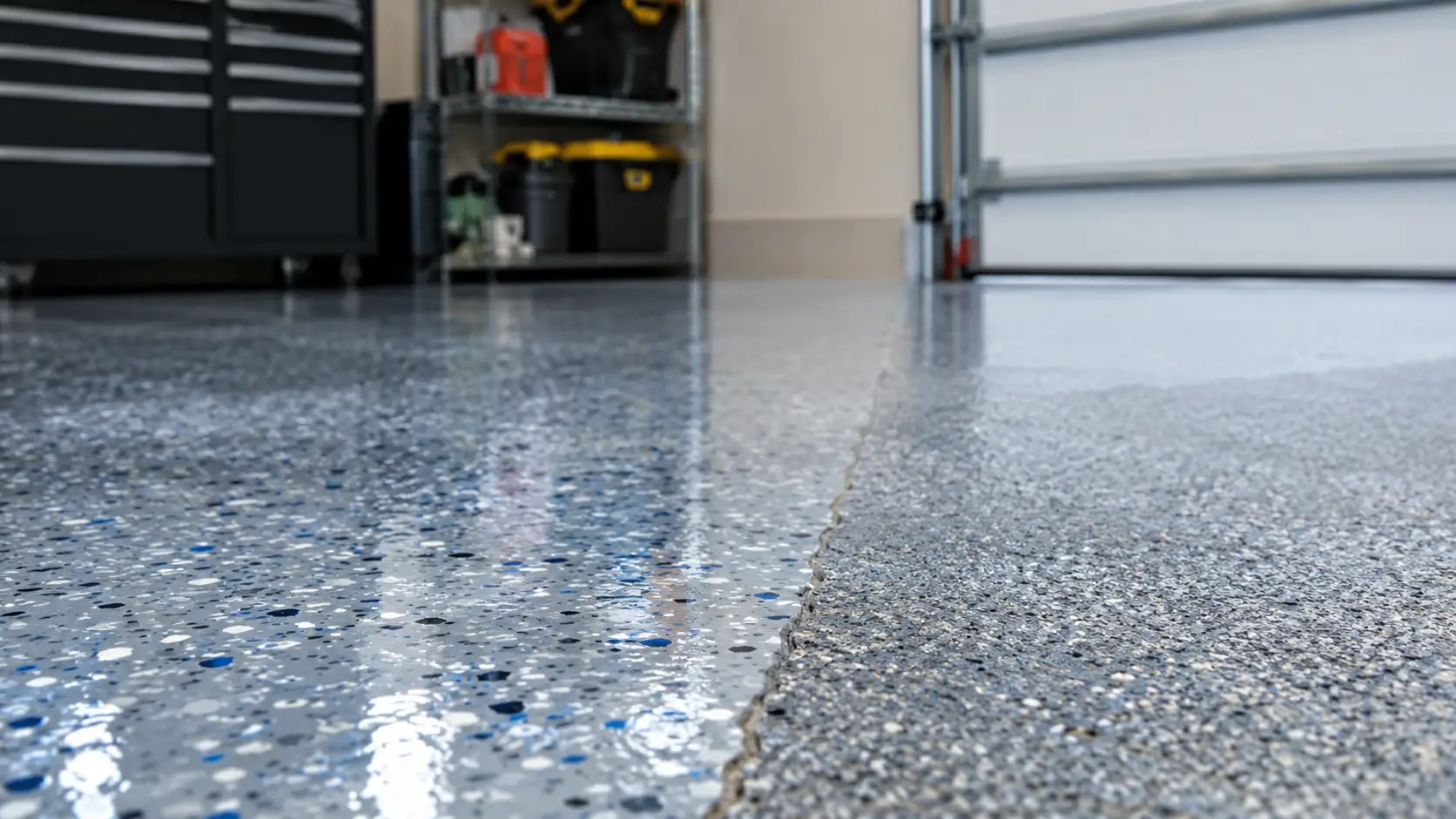
Polyaspartic coatings are fundamentally better than standard epoxy for Treasure Valley garage topcoats due to their absolute UV stability, extreme heat resistance, and rapid curing speeds. While moisture-mitigating epoxy remains the superior deep-penetrating primer for bare Idaho concrete, polyaspartic chemistry is required for the final clear layer to permanently prevent yellowing and tire delamination under intense summer exposure.
The Core Chemical Differences
Understanding the chemical engineering behind these two distinct liquid plastics dictates which material belongs on your concrete slab. They are not interchangeable. Each serves a highly specific structural purpose in professional floor coating.
| Feature | 100% Solids Epoxy | Polyaspartic (Aliphatic Polyurea) | Operational Impact |
| Chemistry | Thermosetting polymer | Aliphatic polyurea | Determines curing speed and hardness |
| UV Stability | Low (Ambers and yellows) | Extreme (100% UV stable) | Dictates exterior or direct sun viability |
| Cure Time | Slow (12 – 24 hours per coat) | Rapid (1 – 2 hours per coat) | Determines return-to-service timeline |
| Flexibility | Rigid and dense | Highly elastomeric (flexible) | Determines freeze-thaw crack resistance |
| Concrete Penetration | Deep (Superior primer) | Shallow (Inferior primer on dense concrete) | Dictates the strength of the substrate bond |
(Note: The core chemical distinctions between these thermosetting polymers are standard across industrial materials science, documented extensively in architectural resources like The Construction Specifier.)
Defeating Intense Ultraviolet Radiation in Idaho
The high-desert altitude of the Boise Metro Area results in extreme ultraviolet (UV) radiation during the summer months. This environmental factor alone disqualifies standard epoxy from being used as a clear topcoat.
- The Ambering Failure: Standard industrial epoxies possess immense compressive strength but lack natural UV resistance. When a garage door in Eagle or Star is left open on a summer afternoon, the direct sunlight physically degrades the epoxy resin. Within six to twelve months, the clear epoxy permanently shifts to an ugly, hazy amber or yellow hue.
- The Polyaspartic Immunity: Polyaspartic is formulated as an aliphatic compound. This specific chemical structure is inherently immune to ultraviolet degradation. A polyaspartic clear coat will remain crystal clear and optically flawless for decades, regardless of how much direct Idaho sunlight it absorbs.
- Driveway Apron Protection: The concrete lip where the garage floor meets the exterior driveway (the apron) receives constant sun exposure. Applying polyaspartic guarantees this highly visible transition zone never fades, chalks, or yellows.
Thermal Shock and Elastomeric Flexibility
Concrete slabs in Ada and Canyon counties undergo violent thermal expansion and contraction. Summer days hit 105°F, while winter nights plunge to 15°F. Your floor coating must survive this movement.
- Epoxy Rigidity: Fully cured 100% solids epoxy is incredibly hard and rigid. While this creates a high impact resistance against dropped tools, its rigidity makes it vulnerable to structural concrete shifts. When an Idaho concrete slab expands in extreme heat, rigid epoxy cannot stretch. It snaps, creating microscopic hairline fractures in the clear coat.
- Polyaspartic Elasticity: Polyaspartic coatings dry hard but retain microscopic elastomeric properties. This means the clear coat can physically stretch, flex, and move in tandem with the concrete slab as it expands and contracts throughout the freezing Caldwell winters and boiling Nampa summers.
- Bridging Micro-Cracks: Because polyaspartic can flex, it excels at bridging the microscopic surface cracks that naturally form in aging residential concrete, keeping the floor entirely seamless and structurally sealed against moisture.
Resistance to Hot Tire Pick-Up and Chemical Stains
Garages are heavy utility spaces. The flooring must resist massive temperature transfers from vehicle tires and highly corrosive automotive fluids.
- Summer Heat Transfer: Driving on Meridian asphalt in July superheats vehicle tires to over 140°F. Both 100% solids epoxy and commercial polyaspartic systems are dense thermoset plastics. Unlike cheap DIY hardware-store paints, neither material will melt, reactivate, or peel off under extreme hot tire contact.
- Chemical Blockade: Both polyaspartic and epoxy form completely non-porous membranes over the concrete. They are highly resistant to motor oil, transmission fluid, and antifreeze.
- Polyaspartic Stain Superiority: Polyaspartic edges out standard epoxy regarding resistance to highly acidic or corrosive agents. It offers superior long-term resistance to magnesium chloride road salts, DOT 4 brake fluid, and aggressive industrial solvents.
The Hybrid Solution: The True Industry Standard
Marketing campaigns often pit “Epoxy vs. Polyaspartic” as a forced choice for consumers. In reality, the most resilient, commercial-grade garage floors in the Treasure Valley do not rely exclusively on just one chemical. They utilize a hybrid system to leverage the exact strengths of both materials.
- The Base Coat (Moisture-Mitigating Epoxy): Professional installers always use epoxy for the primer layer. Epoxy has a slower cure time, allowing it to remain in a liquid, low-viscosity state longer. This allows the resin to sink deep into the open pores of the mechanically ground concrete, creating an unbreakable, deep-penetrating mechanical bond. It also acts as a critical vapor barrier against high ground moisture during the Boise spring thaw.
- The Flake Broadcast (Vinyl Chips): While the epoxy primer is still wet, installers broadcast the decorative vinyl chips to full rejection, embedding them permanently into the epoxy foundation.
- The Topcoat (Polyaspartic): Once the epoxy base is fully cured and scraped flat, the crew applies a high-build polyaspartic clear coat. This leverages polyaspartic’s rapid curing speed, ultimate UV stability, and extreme chemical resistance precisely where it is needed—on the very top surface exposed to sunlight and tires.
Installation Speed and Convenience
The curing speeds of these chemicals directly dictate how long your garage is out of commission. For active households in Boise and Kuna, minimizing downtime is a massive logistical priority.
- Multi-Day Epoxy Systems: A floor utilizing epoxy for both the base coat and the topcoat requires mandatory waiting periods between layers. It typically takes two to three days to install, followed by an additional 72 hours before the chemical is hard enough to support the weight of a passenger vehicle.
- One-Day Polyaspartic Systems: Because polyaspartic cures in a matter of hours, contractors can patch, grind, coat, flake, and clear-coat a standard two-car garage in a single 8-hour workday.
- Rapid Return to Service: Polyaspartic cross-links incredibly fast. Homeowners can safely walk on the floor within 12 hours and park heavy SUVs back inside the garage just 24 hours after the installation crew leaves the driveway.
Securing the Right System for Your Slab
Never guess which chemical system your concrete requires. A flawless floor depends entirely on a professional assessment of your slab’s moisture levels, sun exposure, and the structural integrity of the existing concrete.
Contact Meridian Epoxy Flooring to ensure the correct industrial materials are applied to your specific environment. Visit our contact page today to schedule a free, exact site evaluation and custom estimate for your home in Meridian, Boise, Nampa, Caldwell, Eagle, Kuna, or Star.