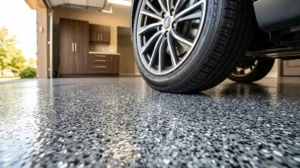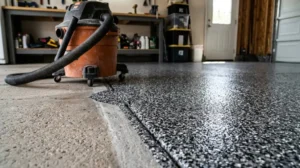
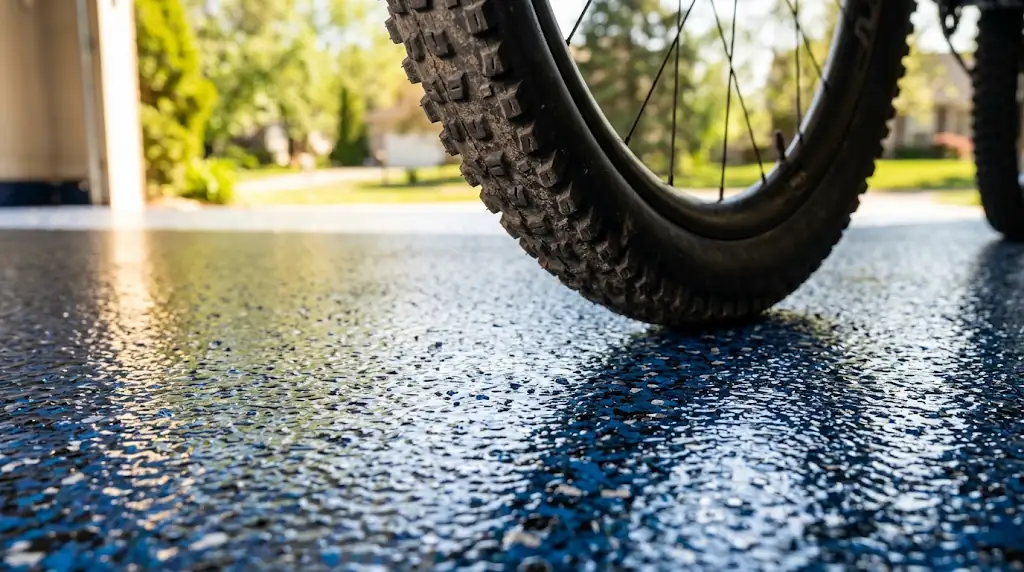
The best time to install epoxy flooring in the Boise Metro Area is during the spring (April to June) and fall (September to October). During these transitional seasons, ambient temperatures consistently hold between 55°F and 75°F, providing the exact thermal window required for professional floor grinding and flawless chemical curing.
How Treasure Valley Seasons Dictate Curing Times
Epoxy does not “dry” like standard wall paint. It undergoes an exothermic chemical reaction where the resin and hardener cross-link to form a dense plastic. This chemical reaction is entirely dependent on the ambient air temperature and the surface temperature of the concrete slab.
| Installation Season | Average Ambient Temperature | Curing Speed | Structural Vulnerability |
| Spring (Apr – Jun) | 55°F – 75°F | Optimal / Controlled | Minimal risk of thermal shock |
| Summer (Jul – Aug) | 85°F – 100°F+ | Accelerated / Flash Curing | Roller marks, poor concrete penetration |
| Fall (Sep – Oct) | 60°F – 75°F | Optimal / Controlled | Minimal risk of moisture intrusion |
| Winter (Nov – Mar) | 25°F – 45°F | Delayed / Stalled | Resin freezing, blushing, delamination |
(Note: Temperature data aligns with historical climate averages for Ada and Canyon counties provided by the National Weather Service Boise.)
Spring and Fall: The Peak Installation Windows
Spring and autumn offer the safest, most predictable environments for chemical floor coatings in Idaho. Garages in Meridian, Nampa, and Eagle are typically unheated and uninsulated, meaning the interior slab temperature closely mirrors the outdoor weather.
- Optimal Concrete Penetration: Proper adhesion requires the liquid epoxy primer to sink deep into the microscopic pores of the ground concrete before it hardens. Mild temperatures keep the epoxy in a low-viscosity (thin) state longer, allowing for maximum substrate penetration.
- Ideal Working Times: Installers require adequate “pot life” (the time the mixed chemical remains workable in the bucket). At 65°F, contractors have ample time to cut in edges, roll the base coat evenly, and broadcast vinyl flakes without the material turning into a solid block mid-application.
- Predictable Outgassing: Concrete breathes. As air temperatures rise during the day, the air inside the concrete expands and pushes outward. In moderate spring and fall weather, this outgassing is minimal. Extreme outgassing causes microscopic air bubbles to become trapped in the curing epoxy, creating surface pinholes.
The Risks of Summer Installations in Southwestern Idaho
Summer in the Boise Metro Area brings aggressive heat. July and August routinely produce daytime highs exceeding 95°F. This intense heat fundamentally alters how epoxy chemicals behave.
- Flash Curing: When concrete surface temperatures surpass 85°F, standard epoxy cross-links aggressively. The chemical “pot life” drops from 45 minutes to less than 15 minutes. The epoxy flash-cures on the floor, failing to penetrate the concrete pores and resulting in a weak mechanical bond.
- Application Defects: Because the material hardens almost instantly, installers cannot maintain a wet edge. This leaves permanent, visible roller marks and thick lap lines trapped under the clear topcoat.
- Polyaspartic Solutions: To successfully install floors during Treasure Valley summers, professional contractors abandon standard epoxies. They utilize high-build polyaspartic and polyurea systems engineered specifically for high-temperature applications, allowing for proper adhesion even in 100-degree weather.
Navigating Winter Installations in Ada and Canyon Counties
Winter installations in Caldwell, Kuna, and Star present entirely different chemical challenges. When temperatures drop below freezing, standard epoxy systems completely fail to cure.
- Viscosity Spikes: Cold weather turns liquid epoxy resin thick and viscous, resembling cold molasses. Thick epoxy cannot penetrate the CSP-2 concrete profile created by the planetary grinders. It simply sits on top of the cold slab and easily peels off later.
- Amine Blush: Standard epoxies applied in cold, damp winter environments frequently develop amine blush. This chemical reaction between the hardener, moisture, and carbon dioxide leaves a sticky, greasy, white film on the surface of the floor that destroys the adhesion of the clear topcoat.
- Winter-Grade Formulations: Professional crews install floors year-round in Idaho by switching to specialized extreme-cold weather polyaspartic formulations. These specific aliphatic polyureas are catalyzed to cure flawlessly at temperatures as low as -20°F, bypassing the limitations of traditional epoxy.
Soil Moisture and the Spring Thaw
Temperature is only half of the seasonal equation. Moisture vapor transmission (MVT) dictates the absolute success or catastrophic failure of a concrete floor coating.
- Hydrostatic Pressure: As the heavy Idaho winter snowpack melts in early spring, the water table in certain Treasure Valley neighborhoods spikes. This groundwater creates severe hydrostatic pressure, pushing moisture vapor upward through the unsealed concrete garage slab.
- Moisture Testing: A professional installation crew takes precise calcium chloride or relative humidity (RH) concrete moisture readings regardless of the season.
- Vapor Barrier Primers: If moisture readings exceed 4 pounds per 1,000 square feet, the ambient air temperature is irrelevant. The contractor must apply a specialized moisture-mitigating epoxy primer to hold back the hydrostatic pressure, ensuring the topcoats do not blister and pop off the floor.
Year-Round Professional Capabilities
While spring and fall are scientifically the most effortless seasons for curing resin, property owners are not restricted to these months. Commercial-grade chemical engineering allows for flawless year-round installations.
Amateur box-store paint kits dictate that you must wait for a perfect 70-degree Saturday. Professional contractors stock distinct chemical lines for the dead of winter and the peak of summer. The true “best time” to install a protective garage floor coating is immediately before your bare concrete sustains further damage from winter road salts or summer hot-tire wear.
Secure your spot on the installation calendar before seasonal rushes fill the schedule. Contact Meridian Epoxy Flooring to get a permanent, commercial-grade flooring system installed in your home, regardless of the weather outside. Visit our contact page today to schedule a free, exact site evaluation and estimate for properties in Meridian, Boise, Nampa, Caldwell, Eagle, Kuna, and Star.