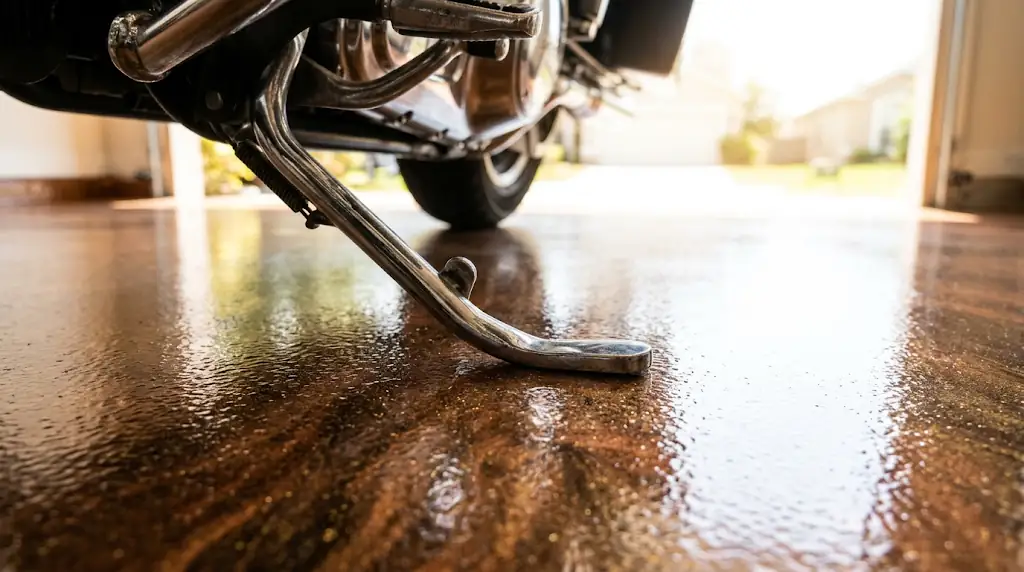
Yes, professionally installed epoxy and polyaspartic garage floors easily withstand the extreme heat of Treasure Valley summers. Industrial-grade coatings are chemically engineered to handle ambient garage temperatures exceeding 120°F and resist the 140°F thermal shock from hot vehicle tires without peeling, melting, or delaminating.
The Threat of Hot Tire Pick-Up in Idaho
The single greatest threat to a painted garage floor during a Boise heatwave is a phenomenon known as “hot tire pick-up.” When you drive on sun-baked asphalt in Meridian or Nampa during July and August, your vehicle’s tires absorb immense amounts of heat. By the time you park in your garage, the rubber tread can easily exceed 140°F.
- The DIY Paint Failure: Cheap, water-based DIY epoxy kits from local hardware stores lack structural heat resistance. When a scorching hot tire parks on these thin paints, the heat instantly melts and reactivates the acrylic binders.
- The Cooling Contraction: As the garage cools overnight, the rubber tire contracts and physically bonds to the melted paint.
- The Peeling Effect: The next time you reverse your car out of the garage, the tire physically rips the weakened paint right off the concrete slab, leaving bare patches.
- The Professional Solution: Commercial 100% solids epoxy and polyaspartic topcoats form a dense, highly cross-linked thermoset plastic. Once fully cured, they will not melt, soften, or reactivate under vehicular heat. They offer absolute immunity to hot tire pick-up.
Heat Resistance of Garage Flooring Materials
Different chemical formulations react drastically differently to extreme ambient heat and direct thermal transfer. Understanding these thresholds prevents costly flooring failures.
| Flooring Material | Heat Resistance Threshold | Susceptibility to Hot Tire Pick-Up | Structural Integrity in Summer |
| Bare Concrete | High | None | Absorbs oil rapidly in high heat |
| 1-Part Acrylic Floor Paint | Low (Softens at 90°F) | Extreme | Melts, blisters, and peels |
| Water-Based DIY Epoxy | Moderate (Softens at 110°F) | High | Delaminates under vehicular weight |
| 100% Solids Industrial Epoxy | Very High (Stable at 150°F+) | None | Remains structurally rock-hard |
| Polyaspartic/Polyurea | Extreme (Stable at 200°F+) | None | Remains rock-hard and UV stable |
(Note: Material heat tolerances align with standard industrial chemical data for thermosetting polymers and aliphatic polyureas.)
Combating UV Degradation in Eagle and Star
Heat is only one component of a Treasure Valley summer. The intense, high-altitude ultraviolet (UV) radiation from direct Idaho sunlight destroys inferior flooring systems.
- The Ambering Effect: Standard industrial epoxy resins are exceptionally strong but are not naturally UV stable. When exposed to direct sunlight along the garage apron (the lip where the garage door meets the driveway), the UV rays cause the chemical composition of the epoxy to degrade. This results in “ambering,” where the clear coating turns a hazy, ugly yellow.
- South-Facing Vulnerability: Homes in Eagle, Star, and Kuna with south- or west-facing garages endure brutal afternoon sun exposure. A standard epoxy topcoat will chalk and yellow within a single summer in these conditions.
- The Polyaspartic Advantage: To defeat intense summer UV rays, professional contractors seal the garage floor with a specialized polyaspartic topcoat. Polyaspartic chemistry is inherently UV-stable. It completely blocks ultraviolet radiation, ensuring the floor’s clear coat never ambers, chalks, or fades, regardless of how much direct Idaho sun it absorbs.
Managing Thermal Shock and Concrete Expansion
Concrete is not a static material. As ambient temperatures in Ada and Canyon counties fluctuate wildly from a cool 60°F morning to a blistering 105°F afternoon, the concrete slab physically expands and contracts.
- Micro-Cracking: When a massive concrete slab expands in the summer heat, the rigid surface is put under immense tension. If a rigid, inflexible coating is applied to the surface, the moving concrete will snap the coating, creating thousands of microscopic hairline cracks.
- Elastomeric Properties: High-quality polyurea and epoxy primers possess built-in elastomeric flexibility. This means the coating can microscopically stretch and flex in tandem with the expanding concrete slab.
- Expansion Joint Protection: Professional installers never coat over the deep expansion joints (saw cuts) in your concrete with rigid epoxy. They fill these critical stress-relief zones with a highly flexible polyurea joint filler. This allows the concrete slabs to expand into the joints during hot summer afternoons without buckling or shattering the seamless floor coating above.
Installation Challenges During a Boise Heatwave
While fully cured epoxy easily withstands summer heat, the installation process during July and August requires highly specialized chemical management. Summer installations dictate exactly which materials a contractor can successfully apply.
- Flash Curing: Heat accelerates the chemical cross-linking of resin. If a contractor applies a standard epoxy primer to a 95°F concrete slab in Caldwell, the chemical will “flash cure” in a matter of minutes. It hardens before it has time to seep deep into the microscopic pores of the concrete, resulting in a weak surface bond that will eventually peel.
- Pot Life Reduction: Installers rely on adequate “pot life”—the time the mixed chemical remains liquid in the bucket. In extreme heat, standard epoxies turn into a smoking, solid block of plastic inside the mixing bucket before they can even be poured onto the floor.
- High-Heat Formulations: Professional crews operate flawlessly during summer heatwaves by switching out their chemical inventory. They utilize specialized, slow-cure polyaspartics and high-heat primers engineered specifically for hot-weather application. This ensures maximum concrete penetration and a flawless, roller-mark-free finish, even on the hottest days in August.
Humidity and Moisture Considerations in Summer
Unlike the stifling humidity of the East Coast or the South, the Treasure Valley is characterized by an arid, high-desert climate.
- Low Relative Humidity: Boise summers are incredibly dry, which is excellent for chemical curing. High humidity introduces moisture vapor into the air, which can cause standard epoxies to “blush” (leaving a cloudy, sticky film on the surface). Idaho’s dry summer heat eliminates this risk entirely, resulting in high-gloss, crystal-clear topcoats.
- Deep Earth Moisture: Despite dry air, the soil underneath the concrete slab can hold high levels of trapped moisture from the spring thaw, particularly in areas near the Boise River. As the summer sun heats the garage slab, it pulls this trapped earth moisture rapidly upward through the concrete pores in the form of vapor.
- Vapor Barrier Necessity: Professional installers never assume a slab is dry just because it is July. They conduct moisture testing year-round. If hydrostatic pressure is present, a dedicated moisture-mitigating primer is applied to lock out the rising vapor, preventing summer heat blisters from forming under the coating.
Prepare Your Garage for the Heat
Do not waste your weekend applying a cheap hardware-store paint kit that will inevitably melt onto your tires the first time the temperature spikes over 100 degrees. Protect your concrete investment with a permanent, industrial-grade coating engineered for extreme environments.
Contact Meridian Epoxy Flooring to secure a flooring system guaranteed to survive the harshest Idaho summers. Visit our contact page today to schedule a free, exact site evaluation and custom estimate for your home in Meridian, Boise, Nampa, Caldwell, Eagle, Kuna, or Star.